



Which Passports Get Visa on Arrival in Dubai?
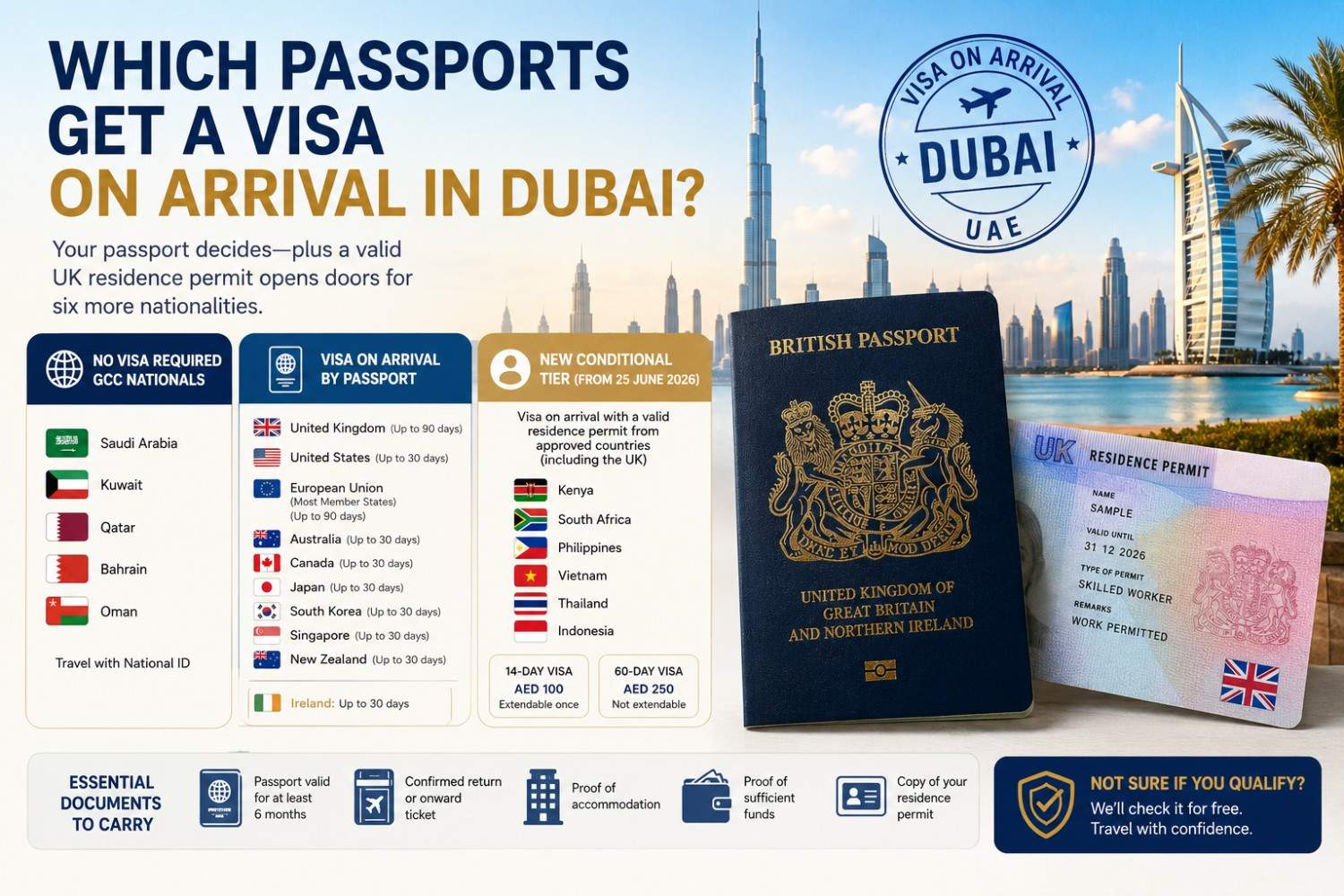
If you’re checking eligibility for a visa on arrival in Dubai, it depends mainly on your passport, but a valid UK residence permit now opens the door for six more nationalities too. According to GDRFA and ICP UAE, eligibility is spread across three clear tiers, and knowing which one applies to you takes just a minute.
Passport Nationality vs UK Residency: What Actually Decides Your Eligibility
Your eligibility nationality is the primary rule.
For most travellers, the passport you have is what determines whether you can walk up to the UAE immigration and get stamped in without applying in advance. Citizens of the UK, the EU, the US, and a long list of other countries have enjoyed automatic visa-on-arrival access for years, and that hasn’t changed. GCC nationals aren’t in the system entirely, since they don’t need a visa at all. For everyone else, the starting point is always, ‘What does my passport say?’
The exception: how a UK residence permit changes things for six nationalities
Since 25 June 2026, the rules have widened. Nationals of Kenya, South Africa, the Philippines, Vietnam, Thailand, and Indonesia who previously had to apply for a UAE visa in advance can now get a visa on arrival too, but only if they hold a valid residence permit from one of nine approved countries, including the UK. This means a Filipino or Kenyan national living in Britain on a valid Skilled Worker visa, for example, could potentially use that UK residence status to qualify, provided the permit itself meets the criteria set out below. It’s a genuinely useful shortcut for UK-based residents from these six countries, but it comes with conditions worth understanding properly before you book.
Not sure which category applies to you? We’ll check it for free.
Full Visa on Arrival Eligibility List (2026)
GCC nationals: no visa required
Citizens of Gulf Cooperation Council countries, Saudi Arabia, Kuwait, Qatar, Bahrain, and Oman don’t need a visa or a visa on arrival to get into the UAE. They can travel using their national ID card in most cases, making this the simplest entry category by far.
Nationalities with an automatic visa on arrival
These passport holders can get a visa on arrival based on nationality alone, with no residence permit needed.
|
Nationality |
Stay allowed |
Notes |
|
United Kingdom |
Up to 90 days | Renewable in some cases; check current terms with ICP |
|
United States |
Up to 30 days | Extendable |
|
European Union (most member states) |
Up to 90 days |
Varies slightly by country |
| Australia | Up to 30 days |
Extendable |
| Canada | Up to 30 days |
Extendable |
|
Japan |
Up to 30 days | Extendable |
|
South Korea |
Up to 30 days |
Extendable |
| Singapore | Up to 30 days |
Extendable |
| New Zealand | Up to 30 days |
Extendable |
Ireland is worth calling out because Irish passport holders get a visa on arrival valid for 30 days, separate from the wider EU listing above. Not sure if your nationality qualifies? Check your passport eligibility for a Dubai visa on arrival and apply online if you need an eVisa
New conditional-tier nationalities
This is where the June 2026 update matters most. Passport holders from Kenya, South Africa, the Philippines, Vietnam, Thailand, and Indonesia can now get a UAE visa on arrival, but only with a valid residence permit issued by one of nine approved countries: the UK, the US, EU member states, Australia, Canada, Japan, South Korea, Singapore, or New Zealand.
There are two options available on arrival:
- A 14-day visa, price is AED 100, which can be extended once.
- A 60-day visa, price is AED 250, which isn’t extendable.
Travellers should verify the current fee structure and any updates with ICP or GDRFA before flying.
If You Hold a UK Residence Permit — What Counts and What Doesn’t
Not every UK immigration document qualifies. The main categories eligible for nationals applying under the UK residence-permit route:
|
UK document |
Qualifies? |
|
BRP (valid) |
Yes |
|
BRP (expired) |
No |
|
ILR (Indefinite Leave to Remain) |
Yes |
| Skilled Worker Visa (valid) |
Yes |
| Graduate Visa (valid) |
Yes |
| Student Visa (valid) |
Yes |
| UK eVisa share code (in place of BRP) |
Generally, yes, but confirm acceptance with your airline and ICP before travel. |
An expired residence permit, even if it expired recently, does not qualify. GDRFA and ICP guidance are consistent on this point. If you have a UK residence permit and want the full picture of your nationality, you can check how this applies to BRP holders.
What If Your Passport Isn’t Eligible?
If your passport does not come under either the automatic or conditional tier, you’re not out of options; you’ll simply need to apply for a UAE visa before you fly, instead of getting one on arrival. This is an easy process, and many applicants are approved within days.
We’ve put together nationality-specific guides to walk you through it:
- Apply for a Dubai visa from the UK for Kenyan citizens.
- Apply for a Dubai visa from the UK for Vietnamese citizens.
- Apply for a Dubai visa from the UK for Thai citizens.
- Apply for a Dubai visa from the UK for South African citizens.
- Apply for a Dubai visa from the UK for Filipino citizens.
- See the full list by nationality.
Apply for your Dubai visa from the UK, and we’ll guide you through exactly what’s needed.
Documents to Carry Even With a Visa on Arrival
Even if you qualify for a visa on arrival, immigration officers can still ask for supporting documents.
- A passport valid for at least 6 months.
- A confirmed return or onward ticket.
- Proof of accommodation.
- Proof of sufficient funds.
- A copy of your residence permit.
If you have all of the things mentioned above, the delays can be avoided at the border, even when you’re technically visa-exempt on arrival.
Worried about airport rejections? Get your documents pre-checked for a Dubai visa on arrival by our DTCM-licensed team.
Common Mistakes That Cause Rejection at the Airport
A handful of avoidable mistakes are the following:
- Using an expired BRP
- Assuming any UK document qualifies
- Travelling with under 6 months’ validity
- Confusing visa-free entry with visa on arrival.
Frequently Asked Questions
Q. Does a UK BRP count?
A. Yes. A valid BRP counts toward eligibility for the 6 conditional-tier nationalities.
Q. Does ILR count?
A. Yes. Indefinite leave to remain is accepted as a valid UK residence status for this purpose, along with the other qualifying visa categories listed above.
Q. My UK visa expired recently. Can I get it?
A. It won’t qualify. GDRFA and ICP guidance treat validity on the day of travel as the deciding factor, regardless of how recently the document expired.
Q. Do skilled worker or graduate visas qualify?
A. Yes, both are accepted as valid UK residence permits for the conditional-tier nationalities, provided they remain valid at the point of entry.
Q. Does the UK e-visa work?
A. Yes. Since the eVisa share code replaces the physical BRP for many holders. Always check the ICP before travel.
Q. What if my passport isn’t eligible?
A. You’ll need to apply for a UAE visa in advance instead of on arrival. See our nationality-specific guides linked above for step-by-step help.
Check your Dubai visa eligibility today, and if you’re travelling from the UK under one of the new conditional-tier rules, apply for your Dubai visa from the UK in advance if you don’t have a qualifying residence permit.