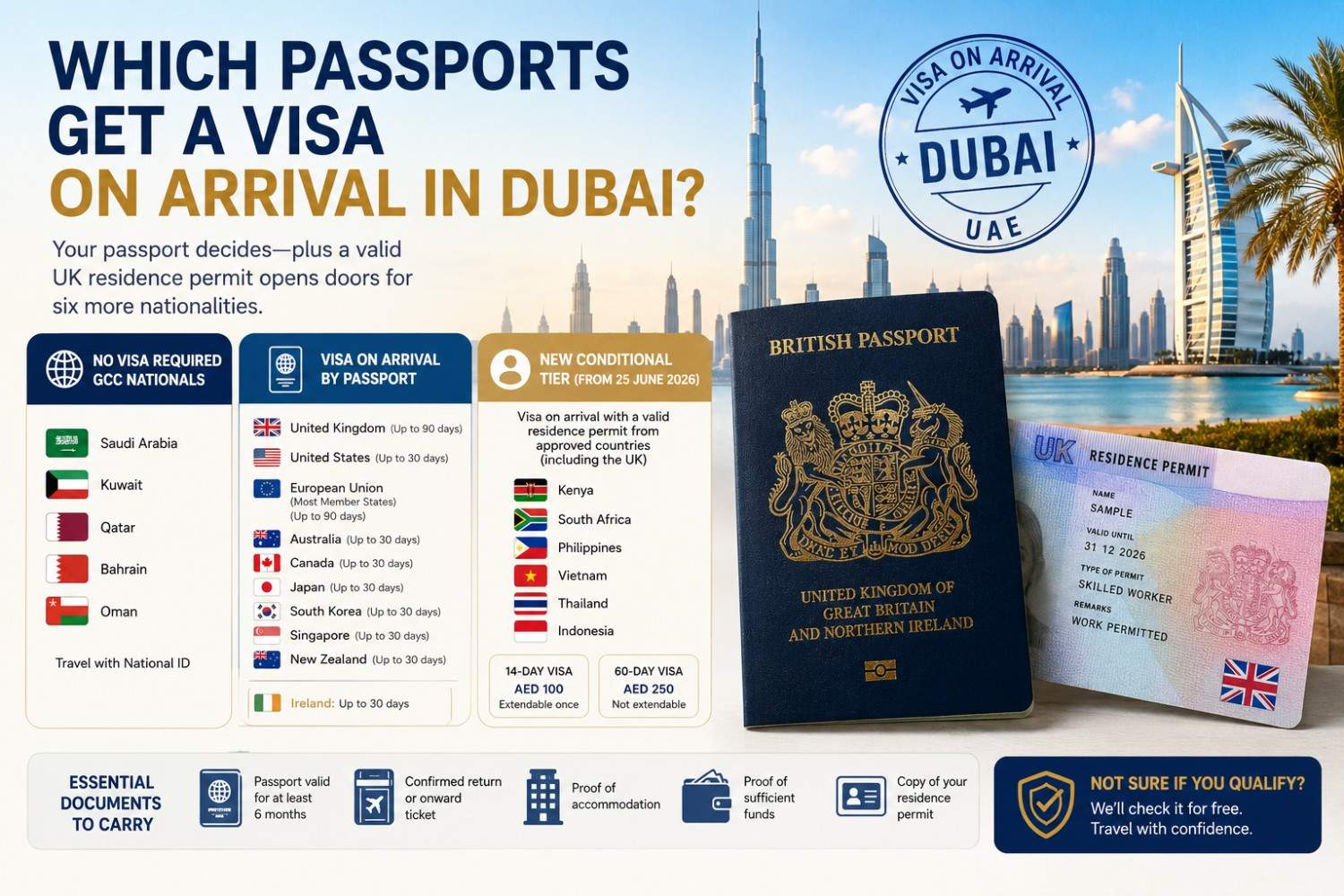



Do You Need a Transit Visa for Dubai Airport?

Quick answer: Most travellers connecting through Dubai International Airport (DXB) do not need a transit visa if they stay airside and continue their journey on a connecting flight within a few hours. You’ll only need a transit visa if you plan to leave the airport, have a long layover with an overnight stay, or your passport nationality isn’t eligible for UAE visa-free entry or visa-on-arrival. It depends on your passport, not on whether you live in the UK.
If you’re only stepping off one plane and onto another, this is usually straightforward. If you want to explore Dubai during a layover, it’s worth checking the details below before you book.
Who This Applies To (Passport Nationality vs UK Residency)
This is the part most transit guides get wrong, and it’s the single biggest source of confusion for UK-based travellers.
Your transit visa requirement is determined by the passport you hold, not by your UK immigration status.
That means:
- A British passport holder living in London and a BRP holder with, say, an Indian, Nigerian, or Pakistani passport living in the same city can have completely different transit visa requirements — even if they’re flying on the same route, on the same day.
- Being a UK resident, having Indefinite Leave to Remain (ILR), or holding a UK eVisa does not grant you any UAE entry or transit privileges. The UAE’s General Directorate of Residency and Foreigners Affairs (GDRFA) and the Federal Authority for Identity and Citizenship (ICP) look at your passport’s country of issue, full stop.
- This matters most for BRP holders, BNO passport holders, and British Overseas Territory passport holders, who often assume their UK residency status carries over to UAE entry rules. It doesn’t.
Bottom line: check the transit rule for the passport you’re travelling on, not the country you live in.
Eligibility Requirements
Whether you need a transit visa for Dubai Airport generally comes down to three factors:
- Your passport nationality – some nationalities can enter or transit the UAE visa-free or via visa-on-arrival; others need a visa arranged in advance, usually through the airline.
- How you’re transiting – staying airside vs. leaving the airport.
- Length of your layover – short connections are treated differently from overnight stopovers.
| Scenario | Typically Need a Transit Visa? |
|---|---|
| Short layover, staying airside, connecting flight same day | Usually no |
| Long layover (overnight), staying airside only | Depends on passport nationality and airline policy |
| Leaving the airport to explore Dubai during a layover | Usually yes, unless visa-exempt or eligible for visa-on-arrival |
| Passport nationality not eligible for UAE visa-free entry/visa-on-arrival | Yes, transit visa required regardless of layover length |
Note: Exact layover-hour thresholds and airline-specific transit visa policies (e.g. Emirates, flydubai) should be confirmed directly with your airline or GDRFA at time of booking, as these can vary by route and change without notice.
Required Documents
If your nationality requires a transit visa, you’ll typically need:
- A passport valid for at least 6 months from your travel date
- A confirmed onward flight ticket showing your connection
- A passport-style photo (digital, as per airline/GDRFA specifications)
- Your UK visa or BRP details, if requested, to confirm your travel history and residency (supporting document only — not a basis for eligibility)
- Any airline-specific transit visa application form, since transit visas are usually sponsored and processed through the airline you’re flying with, not applied for independently
For the full checklist tailored to your situation, see our Required Documents guide.
UAE Transit Visa Processing Time
Transit visas (where required) are usually processed faster than standard tourist visas because they’re arranged through your airline as part of your booking.
- Processing is typically handled before departure, once your flights are booked
- Turnaround can vary depending on the airline and your nationality
- Always confirm current processing times directly with your airline or the official GDRFA channels, as timelines are not fixed and can change based on demand or policy updates
Don’t assume last-minute transit visa approval if your nationality requires one; apply for it as early as possible during booking.
UAE Transit Visa Validity
Transit visas are short-term by design and are meant to cover the duration of your layover only, not extended stays. Validity periods vary by airline and route.
Specific transit visa validity periods should be confirmed with your airline or official UAE immigration sources before booking, as these figures are not standardised across all carriers.
Transit Visa Fees (Where Applicable)
Transit visa fees, when required, are usually built into your airline booking or charged separately by the airline as part of the sponsorship process.
We haven’t listed specific fee amounts here because they vary by airline, nationality, and visa type, and can change without notice. Always confirm current fees directly with your airline before booking.
Step-by-Step: How to Check If You Need One
- Check your passport nationality against the UAE’s visa-free and visa-on-arrival list, not your UK residency status.
- Decide your layover plan — are you staying airside, or leaving the airport?
- Check your layover length with your airline, especially for overnight connections.
- Contact your airline (e.g. Emirates, flydubai) if you’re unsure they sponsor transit visas and can confirm requirements for your specific passport and route.
- Apply early if a transit visa is required, ideally at the time of booking.
- Keep documents ready — passport, onward ticket, and photo in case they’re requested at check-in or on arrival.
Common Mistakes to Avoid
- Assuming UK residency status covers UAE entry rules. It doesn’t — your passport nationality is what matters.
- Leaving the airport without checking eligibility first. If your nationality needs a visa, you can’t simply “wing it” at the border.
- Booking a tight connection without checking transit visa timelines. If you need a visa, factor in processing time before you fly.
- Not checking rules for each passport in a family. Mixed-nationality families (very common among UK residents) often have different requirements per traveller, even when booked on the same itinerary.
- Relying on outdated forum posts or old blog articles. UAE entry rules can change — always verify with your airline or official UAE sources before your trip.
Frequently Asked Questions
Q. What is a Dubai transit visa?
A. A Dubai transit visa is a short-term visa that allows certain passport holders to pass through or briefly enter the UAE while connecting between flights at Dubai International Airport. Requirements are set by GDRFA and ICP guidance and depend on your passport nationality.
Q. Does UK residency affect Dubai transit visa requirements?
A. No. UAE transit visa eligibility is based on your passport’s country of issue, not your UK residency status. BRP holders, ILR holders, and UK visa holders should check requirements for their actual passport nationality, not their address in the UK.
Q. How long does a Dubai transit visa take to process?
A. Processing time depends on your airline and nationality, since transit visas are usually arranged through your airline as part of booking. We recommend confirming current timelines directly with your airline rather than relying on unverified estimates.
Q. What documents do I need for a Dubai transit visa?
A. You’ll typically need a passport valid for at least 6 months, a confirmed onward ticket, and a passport-style photo. For the full checklist tailored to your situation, see our Required Documents guide.
Q. Do I need a transit visa if I’m not leaving Dubai Airport?
A. Often not, if you’re staying airside with a short connection — but this depends on your passport nationality and layover length. Some nationalities need a transit visa even without leaving the airport.
Need Help Planning Your Dubai Trip?
UAE transit and visa rules can feel confusing, especially when your UK residency status doesn’t match your passport nationality. If you’re unsure what applies to you, check your Dubai visa eligibility with our team before you book we’ll help you figure out exactly what’s needed based on your passport, not assumptions.