



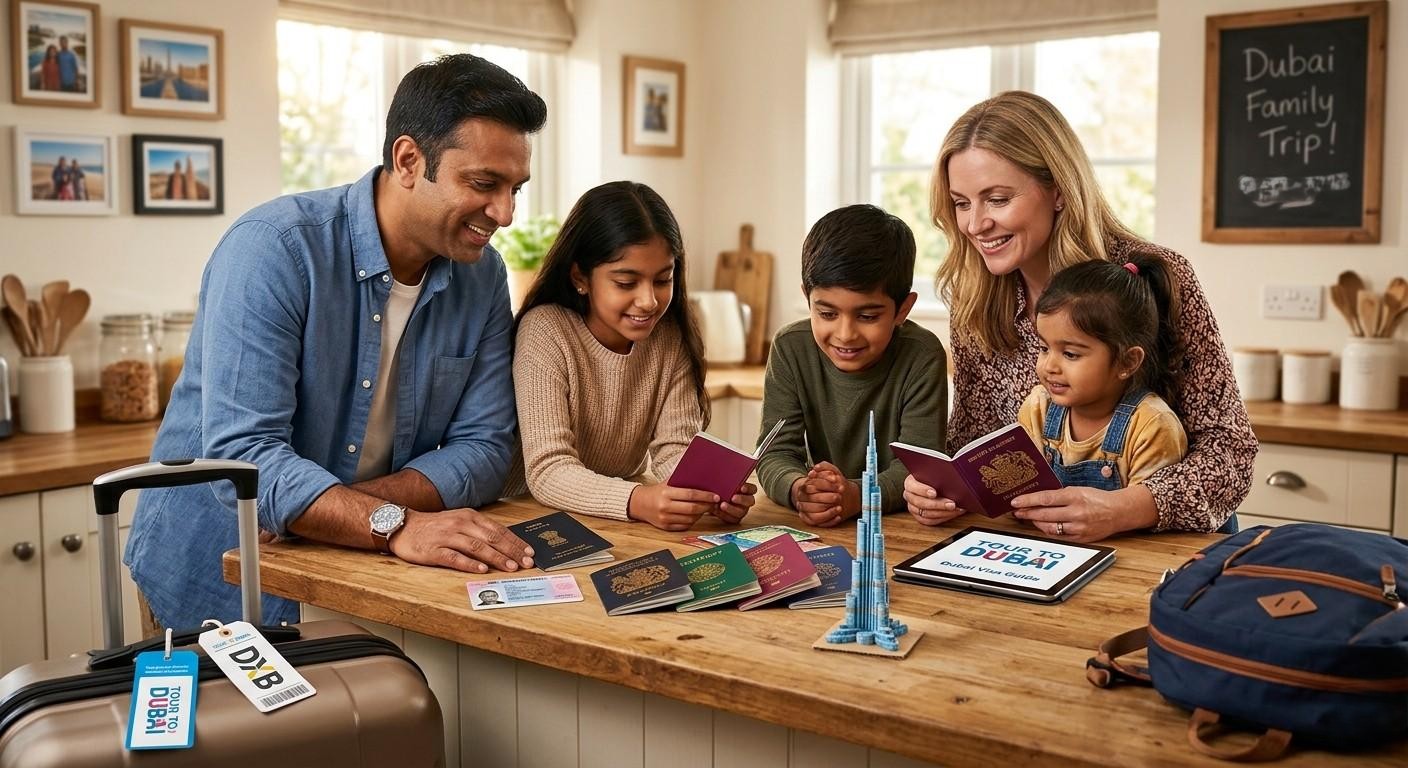
Picture the Sharma-Wilsons heading off for half-term: dad Raj on an Indian passport with UK settled status, mum Charlotte on a British passport, and three children all holding dual British-Indian citizenship. One trip. One household. Five passports. And, technically, three different Dubai visa situations sitting around the same kitchen table. This is the reality for a growing slice of British family life. The UK is home to over 1.92 million people of Indian heritage, and mixed-nationality marriages are now routine, yet UAE visa rules do not care that you all live at the same address. They follow each passport individually.
This guide unpacks exactly who needs what, what is changed under the UK’s new digital eVisa system, and how to handle the whole family’s paperwork without five separate headaches. By the end, you will know precisely how to navigate a mixed-nationality family Dubai visa application and why families typically choose one consolidated route over juggling several.
Why Mixed-Nationality Families Get Caught Out
Here is the single biggest misconception that derails UK families every year: assuming everyone in the household follows the same Dubai entry rules because you all live together, fly together, and share a surname.
You do not.
UAE entry rights follow the passport, not the postcode. A British passport gets you in differently from an Indian one. Your UK residence status, whether that is the old BRP, the new UK eVisa, ILR, or settled status, confirms your right to live in the UK. It does not grant you any UAE entry rights. This catches the Dubai family visa UK market constantly. Travel agents see it weekly: a family books flights, assumes “we will all just turn up at the airport“, and then the non-British member is offloaded at Heathrow Gate 7. The flight goes. They do not.
The fix is simple, but it starts with understanding that your family has multiple visa journeys, not one.
Who in Your Family Actually Needs a Dubai Visa? The Passport-by-Passport Breakdown
The cleanest way to think about this is to forget the family unit and look at each passport on its own. Then bring them back together for one coordinated application. This is the foundation of every UK family Dubai trip visa plan.
British Passport Holders — The Easy Lane
UK passport holders get a free visa on arrival, valid for up to 90 days within a 180-day period. No advance application. No fee. No paperwork beyond a passport with at least six months’ validity past the return date. This is the simplest path in the UAE entry system, and it is how most full-British families fly into Dubai without thinking twice.
Indian Passport Holders Resident in the UK — The Pre-Approved Route
This is where families like the Sharma-Wilsons need to pay attention. Indian nationals do not get the same automatic visa-on-arrival treatment as British citizens. However, under rules restated by the UAE on 29 October 2025, Indian nationals holding valid UK residency (or US or EU residency) are eligible for a 14-day visa on arrival.
A few things to know about the Dubai visa for BRP holder family scenario:
- The qualifying UK residency document (BRP, eVisa, ILR) must have at least six months’ validity remaining on arrival day
- The 14-day permit can be extended once for another 14 days
- Overstay penalties are AED 50 per day
- Airlines now check residency documents at the UK check-in counter. Passengers without qualifying proof are refused boarding
For Indian BRP holders planning longer family trips, a standard 30-day or 60-day Dubai tourist visa applied for in advance is usually the smarter route and avoids the airline check-in lottery entirely.
A Word on Dual Citizenship — Especially for UK-Indian Families
The UK readily permits dual nationality. India does not. India’s constitution does not permit dual citizenship except for minors whose second nationality was involuntarily acquired, and under the Citizenship (Amendment) Rules 2026, a minor child cannot hold an Indian passport and a foreign passport at the same time.
What this means in practice for UK-Indian families: most British-born children of an Indian parent travel on a British passport, with an OCI (Overseas Citizen of India) card linked to it. OCI is a lifelong multi-entry India visa, not citizenship. For UAE purposes, the child is a British traveller. If your child does hold an Indian passport instead (some families choose this), they fall into the same 14-day pre-approval bracket as their Indian parent.
The unbreakable rule: Whichever passport your child uses, enter and exit the UAE on the same passport. Do not switch documents mid-trip. UAE immigration systems link entry and exit records to a single travel document, and a mismatch can mean serious delays at departure.
The Document Checklist for a Mixed-Nationality Family Dubai Visa Application
A scannable list for the Dubai family visa UK application. Save this or screenshot it.
Every Family Member
- Passport with at least six months’ validity past your Dubai return date
- Return flight booking confirmation
- Hotel reservation or address of accommodation
- Travel insurance (strongly recommended)
Non-British Passport Holders Only
- BRP front and back, or UK eVisa share code (UKVI)
- Recent passport-style photograph on a white background
- Occupation details and basic employment information
Children on Non-British Passports
- Their own passport, photo, and full Dubai visa for children UK application
- Birth certificate showing both parents
- Copies of both parents’ passports
Save yourself the back-and-forth. Tour To Dubai’s licensed UAE team reviews documents before submission and flags issues most applicants only spot when they get a rejection email. One Dubai family visa UK application, one point of contact, one invoice for the whole household.
Comparing Application Routes: Which Way Should a Mixed-Nationality Family Actually Apply?
Three real-world routes for a mixed-nationality family Dubai visa, with the trade-offs each carries.
|
Route |
Best For | Watch Out For |
| Apply separately. British members do visa on arrival, non-British members each apply through different channels | Families with one or two non-British members and lots of time |
Multiple invoices, multiple WhatsApp threads, no single point of accountability if something goes wrong |
|
One licensed UK-based agent for everyone |
Families with mixed passports, especially with young children |
None significant. This is the route most UK families use |
| Apply via the airline | Single travellers in business or first class |
Usually bundled into higher fare classes; rarely economical for family groups |
For a household like the Sharma-Wilsons, one Indian BRP holder, one British passport, and three British children, Route 2 means a single application session covering all five travellers, with the British family members’ visa-on-arrival eligibility confirmed in writing and the Indian father’s 14-day pre-approval processed in advance.
The honest answer: Separate applications can technically work, but most parents juggling family Dubai visa requirements alongside school holiday logistics, packing, and currency exchange find the unified route reduces the cognitive load to near zero.
The Mistakes UK Families Get Wrong Most Often
A short list because most UK family Dubai trip visa problems come from the same recurring errors:
- Assuming everyone in the family has the same visa requirement (the household-passport fallacy)
- Forgetting that BRPs and UK eVisas need to be valid at travel time, not just application time
- UAE visas are valid from the issue date, not the travel date, so a visa issued three months ahead may expire before the trip begins
- Booking the hotel in one parent’s name only, then discovering the children’s applications need their accommodation documented separately
- Missing the notarised consent letter when one parent is travelling alone with the children
- Leaving the non-British passport holder’s application until 48 hours before the flight (then paying for express processing, a problem standard timing would have solved)
- Letting a passport with under six months’ validity slip through, the system rejects it, whether you are on a 90-day or a 14-day route
A Real Case Study: The Sharma-Wilson Half-Term Trip
To make this concrete, here is how a mixed UK-Indian family typically moves through a Dubai family visa UK application, using the Sharma-Wilsons as a worked example.
|
Family Member |
Passport | Route | Action Required |
|
Raj (Father) |
Indian (on UK Skilled Worker BRP) | 14-day pre-approved visa on arrival |
Apply online 7–10 days before travel. Requires a BRP scan, photo, return ticket, and hotel booking. |
|
Emma (Mother) |
British | Free 90-day visa on arrival | None. Walks straight through immigration at DXB. |
| Child 1 (Age 12) | British | Free 90-day visa on arrival |
None |
|
Child 2 (Age 9) |
British | Free 90-day visa on arrival | None |
| Child 3 (Age 4) | British | Free 90-day visa on arrival |
None |
If your family looks more like the Sharma-Wilsons than the textbook nuclear family, you do not need to figure this out alone. Tour To Dubai’s licensed UAE team handles the full mixed-nationality family Dubai visa workflow, checking each passport, verifying BRP validity, and processing all family members in one go.
One Trip, One Application — Without the Stress
Mixed-nationality families are now mainstream in the UK, and so are the mixed-nationality family Dubai visa scenarios that come with them. The Sharma-Wilsons are not an edge case. They are roughly half of the British families flying to Dubai for half-term.
Where it gets harder is doing all of that yourself while also packing for five, lining up airport transfers, and keeping a four-year-old occupied. That’s where a licensed UK-based agent earns its place, not for the visa knowledge, but for taking the coordination off your plate so the family arrives in Dubai with one less thing to argue about.
Ready to apply for the whole family in one go? Tour To Dubai’s licensed UAE visa team handles every UK family Dubai trip visa scenario. Single application, single invoice, one WhatsApp thread until your family lands at DXB. Reviewed by our licensed UAE visa specialists, not generated by a chatbot.
Frequently Asked Questions: Mixed-Nationality Family Dubai Visa from the UK
Q. Does every family member need a Dubai visa from the UK?
A. No. British passport holders get a free 90-day visa on arrival with no advance application. Non-British passport holders living in the UK, including BRP holders, must arrange a visa before flying.
Q. My child has both UK and Indian heritage — which passport should they use for the Dubai family visa UK application?
A. If they hold a British passport, use it. It qualifies for a free 90-day visa on arrival. India does not permit minors to hold both an Indian passport and a foreign passport simultaneously, so most UK-Indian children travel on a British passport with an OCI card.
Q. Can I apply for the whole family in one application?
A. Yes, through a licensed UAE visa agent based in the UK. All family members’ documents are submitted in one session, with one invoice and one point of contact.
Q. Do babies and toddlers need their own Dubai visa?
A. Yes. Every traveller needs their own visa or visa-on-arrival entry, whatever their age.
Q. Is travel insurance mandatory for family Dubai visa requirements?
A. Travel insurance is not always listed as a strict requirement, but it is strongly recommended and increasingly checked at immigration.
